


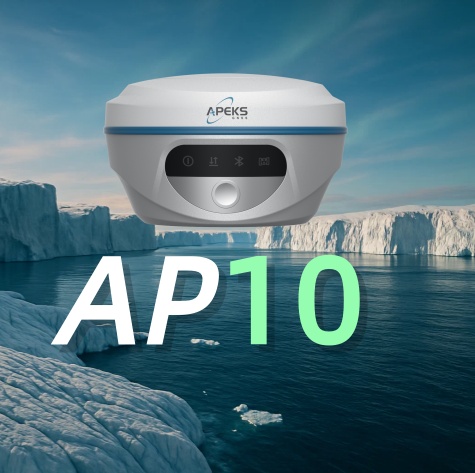

APEKS GNSS Now Listed in NOAA NGS Antenna Calibration Database — AP30 Laser, AP40 Laser+, MAX5
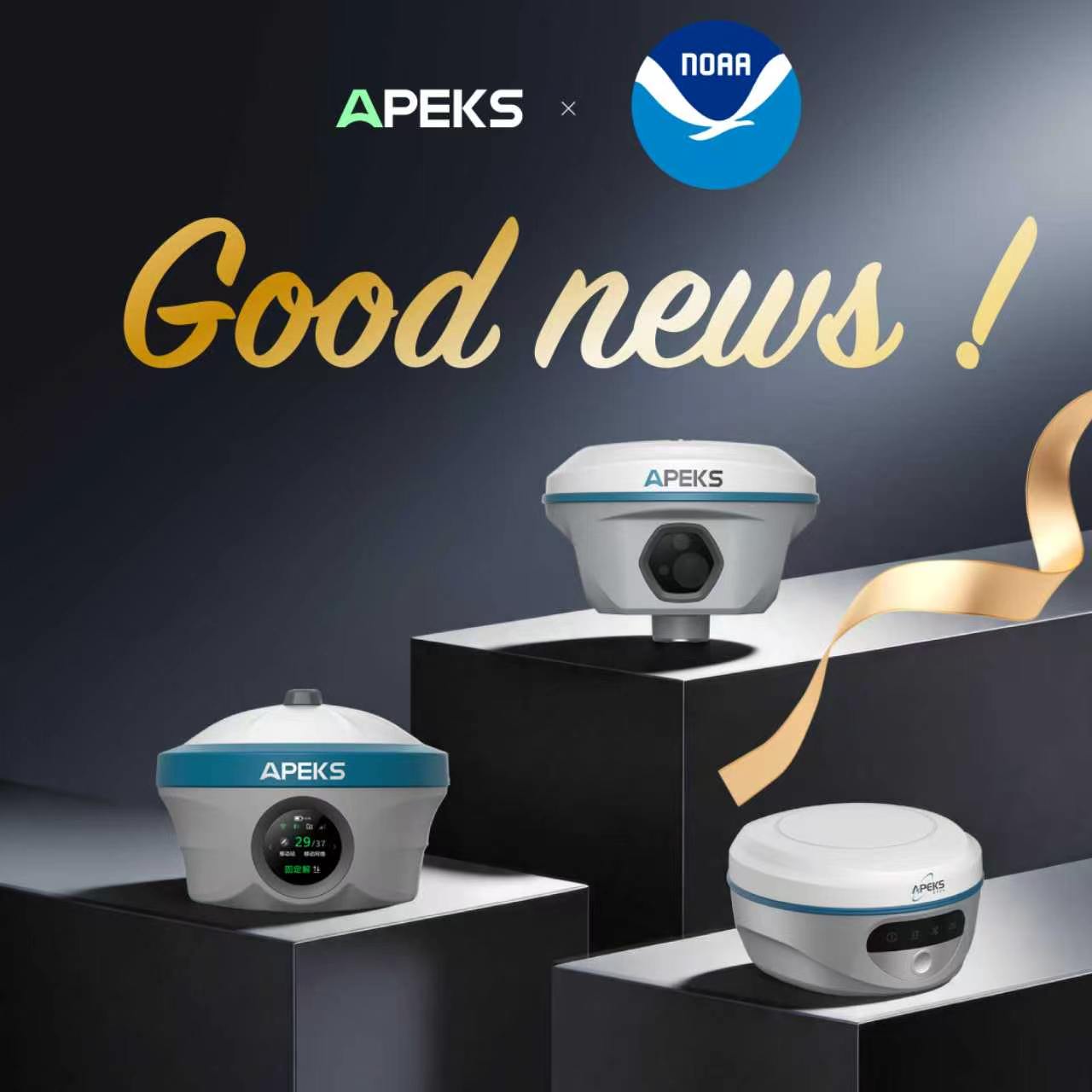
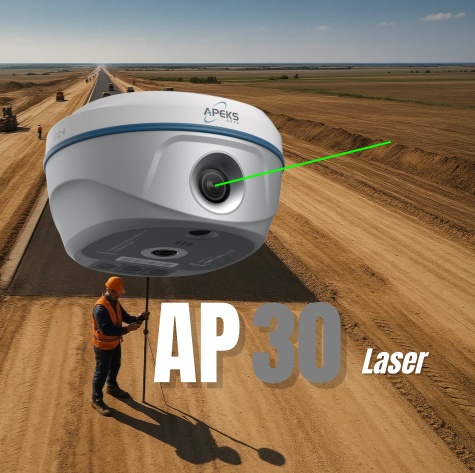
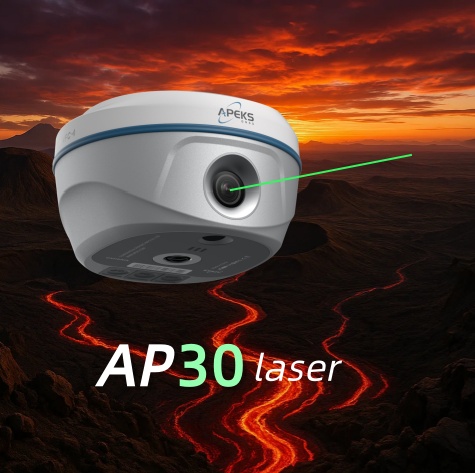
APEKS AP30 Laser, AP40 Laser+, and MAX5 Base Station Receivers are now officially listed in the NOAA National Geodetic Survey (NGS) Antenna Calibration Database (ANTCAL), with absolute calibrations completed in June 2026. NGS antenna calibration is a mandatory requirement for US federal geodetic surveys and is adopted as a reference standard by national mapping agencies across Latin America, including Colombia and Peru. APEKS joins Trimble, Leica, Topcon, and CHC as manufacturers with NGS-certified antenna parameters publicly available at geodesy.noaa.gov/ANTCAL/.
1. What Is NOAA NGS Antenna Calibration?
NOAA NGS National Geodetic Survey, part of the U.S. National Oceanic and Atmospheric Administration — a federal agency established in 1807 and the official geodetic authority of the United States.
NGS Antenna Calibration Database (ANTCAL)is one of the world's most authoritative Gnss Antenna phase center calibration databases. There are only5 absolute calibration facilities globally, and NGS operates one of them (located in Corbin, Virginia).
A 6-axis robotic arm rotates the antenna in three dimensions to measure precise phase center offsets (PCO) and phase center variations (PCV). Calibration formats include ANTEX (IGS format) and ANTINFO (NGS format). These parameters are read directly by all major GNSS processing software, including Trimble Business Center, Leica Infinity, and OPUS.
2. Which APEKS Models Are Now NGS-Listed?
| Antenna Code | Model | Calibration Date | Status |
|---|---|---|---|
| APEAP30LASER | APEKS AP30 Laser | 18-JUN-2026 | Active |
| APEAP40LASER+ | APEKS AP40 Laser+ | 18-JUN-2026 | Active |
| APEMAX5 | APEKS MAX5 Base Station | 21-JUN-2026 | Active |
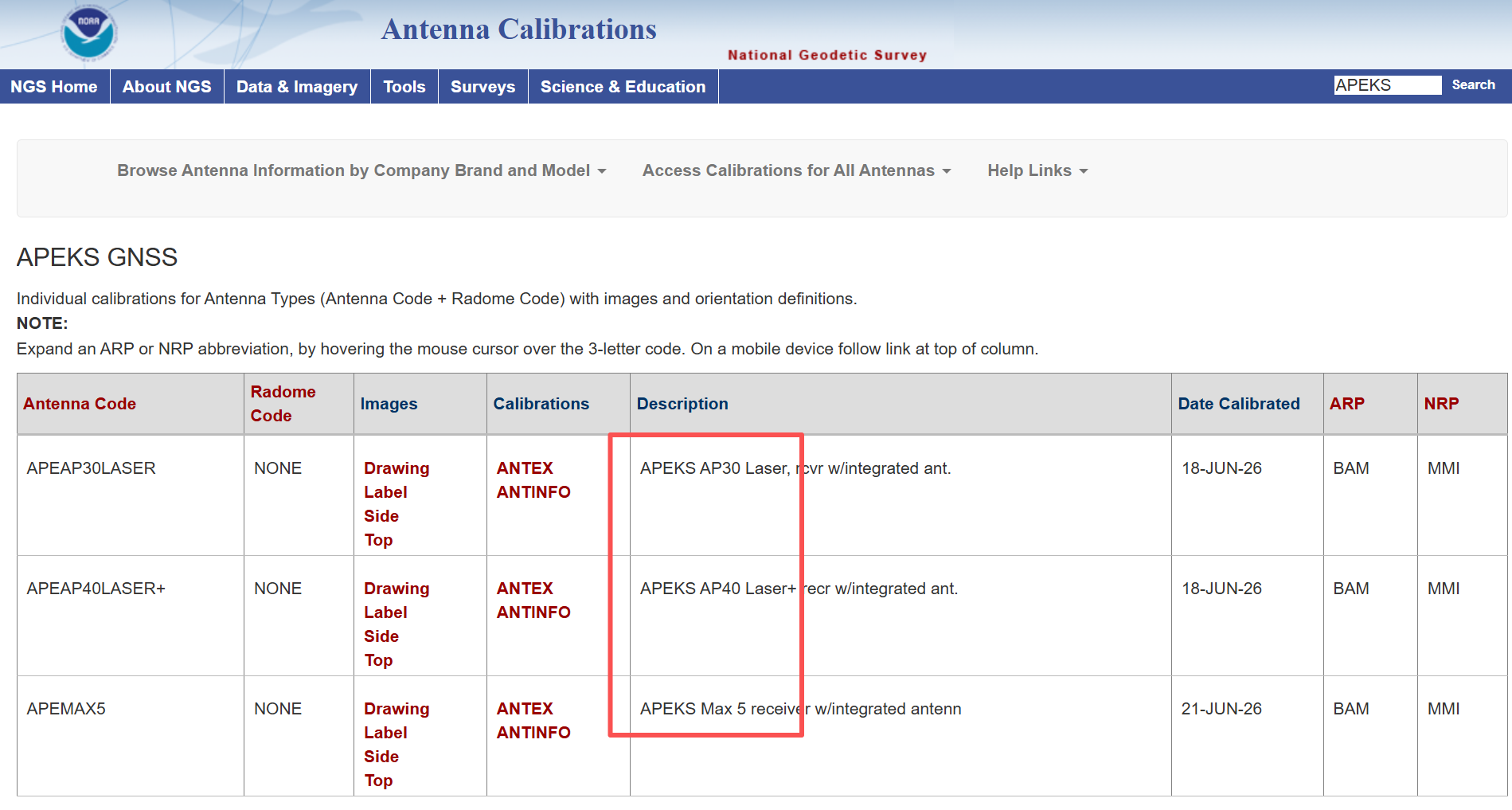
Database link: https://geodesy.noaa.gov/ANTCAL/index.xhtml#
Reference frame: IGS20 (the latest standard, activated in October 2022). ARP: BAM (Bottom of Antenna Mount). NRP: MMI (Manufacturer's Mark or Index).
3. Why NGS Calibration Matters for Your Projects
- Mandatory for U.S. federal projects: All static GNSS data processed with OPUS must use an antenna model from the NGS database; otherwise, height errors can reach 80 cm.
- High-precision post‑processing: NGS calibration includes per‑frequency PCO and PCV values, enabling millimeter‑level accuracy for static and PPK workflows.
- International recognition: IGS adopts NGS calibration methodology, and geodetic agencies in over 200 countries reference IGS/NGS antenna parameters.
- On par with Trimble & Leica: APEKS now appears alongside Trimble, Leica, Topcon, and CHC in the same authoritative database — a clear statement of technical equivalence.
4. Latin America: Government Survey Requirements
🇨🇴 Colombia: IGAC (Instituto Geográfico Agustín Codazzi) requires IGS/NGS-recognized antenna calibration parameters for high‑precision control surveys.
🇵🇪 Peru: IGN (Instituto Geográfico Nacional) processes GNSS control networks according to IGS standards. NGS‑calibrated antenna parameters are directly applicable to Peru's CORS network (RED GNSS IGN).
🇧🇷 Brazil: IBGE (Instituto Brasileiro de Geografia e Estatística) operates the RBMC CORS network using the IGS20 reference frame. NGS calibration data is fully compatible.
General rule: Any government survey project that requires RINEX data submission for post‑processing expects the antenna model to have a calibration record in the IGS/NGS database. Without it, software cannot correctly apply phase center corrections, jeopardizing compliance.
5. How to Use APEKS NGS Calibration Data
AP30 Laser → APEAP30LASER NONE
AP40 Laser+ → APEAP40LASER+ NONE
MAX5 → APEMAX5 NONE
The software will automatically apply the correct phase center corrections.
6. FAQ
What is NOAA NGS antenna calibration and why does it matter?
NOAA NGS antenna calibration is the U.S. federal standard for absolute GNSS antenna phase center characterization. It provides the precise PCO and PCV values required for millimeter-level accuracy in static and PPK surveys, and is mandatory for OPUS submissions.
Which APEKS receivers are now in the NGS database?
The AP30 Laser (APEAP30LASER), AP40 Laser+ (APEAP40LASER+), and MAX5 base station (APEMAX5) are officially listed with calibration dates in June 2026.
Is NGS calibration required for surveying outside the United States?
While not a legal requirement in every country, NGS calibration is adopted as a reference by IGS and recommended by national agencies in Colombia, Peru, Brazil, and many others. Government projects often require antenna parameters from the NGS/IGS database.
How does NGS calibration improve GNSS measurement accuracy?
It corrects for phase center offsets that can introduce errors of several centimeters. Without calibrated PCO/PCV, height errors can reach up to 80 cm in OPUS processing. NGS absolute calibration ensures consistency across different antenna units.
NOAA NGS CERTIFIED. GOVERNMENT-READY. GLOBALLY RECOGNIZED.
APEKS AP30 Laser, AP40 Laser+, and MAX5 are now listed in the NOAA NGS Antenna Calibration Database — meeting the antenna parameter requirements for US federal surveys and Latin American government geodetic projects.
Send an Inquiry → WhatsApp Us →